




A video ad put out on Sept. 23 by the Trump-aligned dark money committee No Going Back PAC Inc. supports the Republican incumbent in Colorado’s 5th Congressional district, Jeff Crank, by attempting to tie his Democratic opponent Jessica Killin to the pornography industry and child sexual abuse. The ad includes a picture of Killin’s home that is internet searchable to her address.
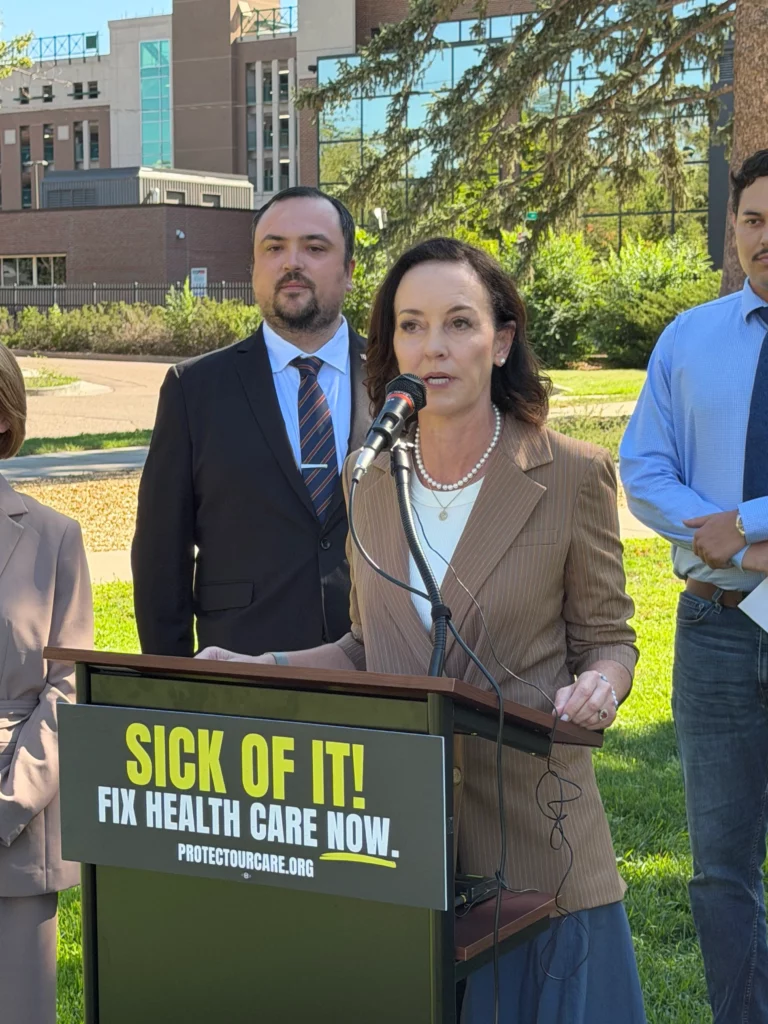
The day after the ad first aired, Killin put out a video response saying the ad created security concerns for her and her family. The video response may be watched here.
“As a candidate, I expect dishonest ads, especially given that my opponent doesn’t have a very good legislative record,” Killin said in the response video. “I can handle it. But as a mother, I find it unacceptable and deeply irresponsible to put my family and my daughter in danger in this era of political violence.”
In her response video, Killin pointed out that, as an elected official, Crank is protected by Colorado’s anti-doxing laws while, as a candidate, Killin is not. Killin said laws should be changed to also keep candidates and their families safe.
Colorado’s once-deep-red fifth congressional district may flip blue this year, bringing the Crank/Killin race national attention – and national dark money campaigns from both sides. The race’s outcome could be a deciding factor in which party controls Congress.
The No Going Back PAC’s ad contains some of the common talking points Crank uses against Killin: she worked in the Biden administration (she was chief of staff for second gentleman Doug Emhoff), she’s a DC insider, etc. But it then goes further, alleging her “family firm” lobbied “for the pornography industry while the industry faced allegations of child sexual abuse.”
No Going Back PAC Inc. has a website, but no way to contact the organization.
Killin’s team said the ad is running on all main stations, cable and streaming.
In April, PBS reported that, “Security spending for congressional and presidential campaigns has jumped fivefold over the past decade as an increasingly hostile political environment has led to escalating threats against public officials, ranging from doxing to assassination plots.”
The PBS article also notes a “a grim roll call of political violence over the past decade” including the 2017 shooting at a Republican congressional baseball team practice in Alexandria, Virginia; the 2022 hammer assault on the husband of Democratic then-House Speaker Nancy Pelosi in California; the 2024 assassination attempt on Republican then-candidate Donald Trump at a Pennsylvania rally; and the assassinations last year of a Democratic Minnesota state lawmaker and her husband, and of conservative commentator Charlie Kirk in Utah.
The (sort of) connection to the porn lobby
Killin was a lobbyist, though for an organization that is decidedly not in the pornography business – she worked for USAA (United Services Automobile Association), an insurance and financial services company for active-duty, veteran, and retired U.S. Army members and their families. Killin is also an Army veteran.
The claim of her alleged tie to the pornography industry – and through that a tie to child sexual abuse – relies on a making a connection through degrees of separation.
Wayne Laugesen, a conservative writer and former editorial pages editor for the Gazette, recently highlighted and emphasized this connection on his Wayne’s Word Substack where he says he “tells the stories no one else will, offering unique perspectives on issues of the day from a pro-market, pro-freedom, pro-individual, pro-Jesus perspective.”
Laugesen’s Substack post is titled “Filth Money: The Porn Lobby Funds Jessica Killin’s Household.”
Laugesen walks readers along the winding trail leading from Killin to the porn industry, starting with Killin’s 19-page public financial disclosure from August, covering the 18 months prior to July 2026. Laugesen notes that most of the disclosures belong to Killin’s husband, Raj Date, who runs the venture capital firm Fenway Summer.
Fenway Summer has holdings in FS Vector LLC, a financial services consulting company which Date founded and where he is a senior advisor.
One of FS Vector’s financial services consulting clients is The Free Speech Coalition which is, as Laugesen notes, “the trade association of the adult entertainment industry.”
Laugesen reports that The Free Speech Coalition was involved in a lawsuit, Free Speech Coalition v. Paxton, which Laugesen characterizes as the Coalition fighting against age checks for children on porn sites along with “every effort Congress attempts to protect children from the industry’s products.” The Coalition lost the case when it went to the Supreme Court.
The ACLU, which represented The Free Speech Coalition in the case, argued the Texas law at issue, HB 1181, oversteps First Amendment protections, was too vague and could apply to sex education sites and R-rated movies. The ACLU said the Act “robs people of anonymity, and threatens to bar individuals – for example, those who lack government identification or whose age is mis-identified by the relevant technology – from accessing the websites altogether.” Laugesen’s “Filth Money” piece does not mention the ACLU’s involvement or its position on HB 1181.
Laugesen also says FS Vector went with the Coalition to Washington to fight age checks for children on porn sites that would be required by the KIDS Act, a package of online safety bills. As evidence, he links to a Free Speech Coalition blog post. However, the blog post does not characterize the trip as fighting against age checks. Rather, it says, “Across party lines, offices engaged seriously with our concerns – particularly around the ineffectiveness of site-level verification and the privacy implications of requiring websites to demand users’ biometrics or government IDs. There was near-universal interest in the idea of basing policy on private, reusable, device-based verification and we expect to hold many more meetings and policy briefings in the months to come.”
Laugesen also reports that co-plaintiffs in the Free Speech Coalition v. Paxton case included MG Freesites and MG Premium, which are owned by Aylo, which is also the parent company of Pornhub. And, in 2023, Aylo admitted in court to profiting from GirlsDoPorn “sex trafficking operation, whose operators tricked and coerced young women into sex videos.” (This is true and only one of the judgments against Aylo which include allowing child pornography to be posted on its site, which may be what the No Going Back PAC ad is referencing).
In summary, Killin’s husband runs a venture capital firm that has holdings in a consulting company he started and advises. One of that consulting company’s clients is the Free Speech Coalition, which represents the adult entertainment industry. The Coalition was a plaintiff in a lawsuit (represented by the ACLU) with co-plaintiffs that included companies run by Aylo. Aylo has received judgments for profiting off sex trafficking and child abuse.
Is the connection from Killin to the pornography industry a meaningful one? Should this connection be placed in a political ad showing her home? These are questions for voters to decide and, in the case of the latter, perhaps lawmakers as well.
Crank’s campaign first put out an anti-Killin ad showing her home, searchable to her home address, less than two weeks before the No Going Back PAC’s ad did.
Independent expenditure committees like No Going Back PAC Inc. are legally barred from coordinating directly with a political campaign.
Crank’s office did not respond to a request for comment.
This article originally appeared in the Pikes Peak Bulletin.
