

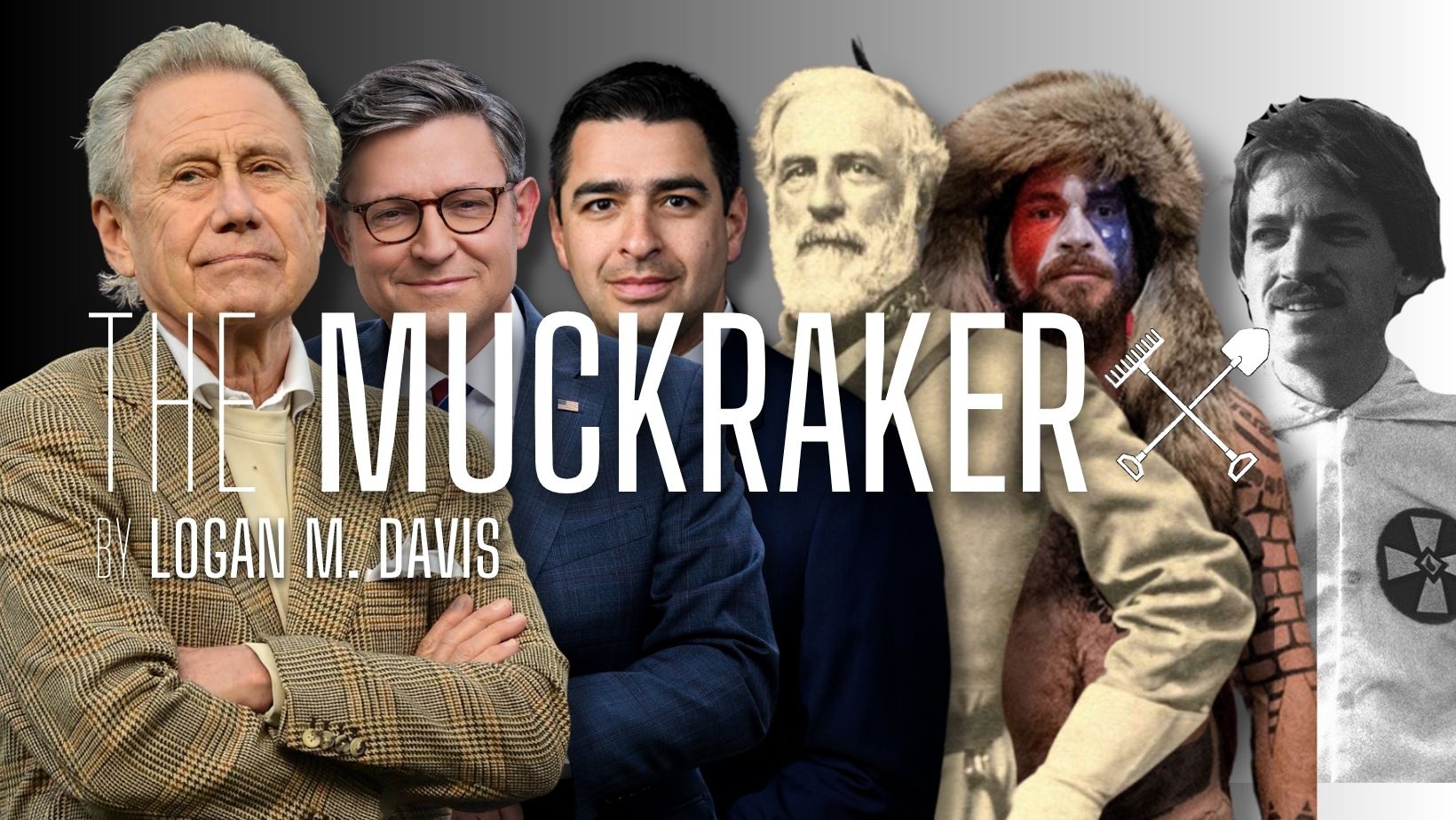
Much has been made of Colorado billionaire Phil Anschutz’s role in shaping state politics: his funding for conservative groups like Advance Colorado and the Common Sense Institute, the way his newspapers work to create a conservative echo chamber in this otherwise blue state, his singular role in shaping the 2026 ballot, and much more. It’s a role which has earned him a reputation as a kind of Chamber of Commerce-style Republican, always focused on the bottom line, never wallowing in the conspiracy-minded soup which has consumed so much of Republican politics and rendered the Colorado GOP a nonentity.
As someone who has spent more time focused on Anschutz’s politics than most, I’m not sure the reputation is accurate.
This week, I took a look at Anschutz’s federal political spending for the 2025-2026 election cycle, which so far totals more than $3 million, per Federal Elections Commission records [as a note: this figure excludes any political activity Anschutz may be engaging in via 501(c)(3)s and (4)s, which his state-level political activity has shown a strong penchant for]. And while parts of what I found were mundane and expected – consistent support for Colorado’s congressional Republicans, large contributions to House and Senate leadership funds and PACs – other parts were surprising enough to raise questions about Anschutz’s home state reputation for being a sensible, business-minded conservative.

Unsurprisingly, much of Anschutz’s federal spending starts at home. During the current election cycle, Colorado’s richest man has donated the maximum allowed $7,000 to three of Colorado’s four incumbent Republican members of congress: Jeff Hurd in the mountainous Third district, Jeff Crank in the Colorado Springs-based Fifth district, and Gabe Evans in the Eighth district north of Denver.
Notably, Anschutz has not given any money directly to the Republican nominee for Colorado’s U.S. Senate race, Mark Baisley. As of the most recent round of campaign finance reports, Baisley has raised a total of about $110,000 – less than one-thirtieth of what Anschutz has personally spent during the election cycle. Democratic incumbent John Hickenlooper has raised nearly $10 million.
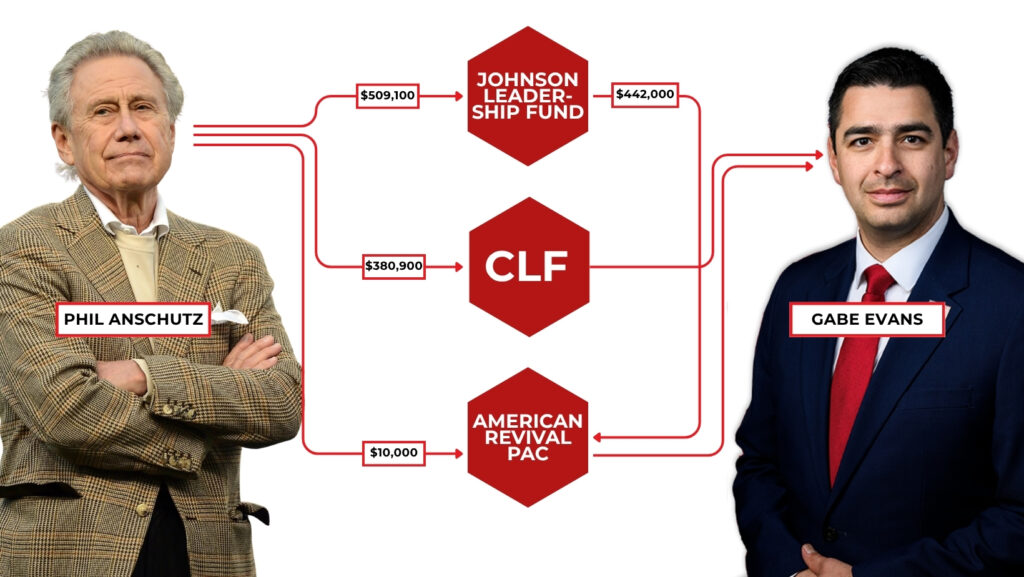
Direct contributions are not the only way Anschutz’s money is supporting the Colorado Republicans in competitive races. Some of the billionaire’s largest contributions of the year have been to the Johnson Leadership Fund (JLF) of House Speaker Mike Johnson (R-LA). This cycle, Anschutz has given $509,100 to the leadership fund, making him by far Colorado’s largest contributor to the committee. No other donors from the state gave more than $25,000 to Johnson’s war chest.
Of that more than half a million dollars Anschutz gave to Johnson’s leadership committee, quite a bit of it seems to have come back towards his own interests. JLF gave $442,000 to the American Revival PAC, also controlled by Johnson, which in turn steered that money towards other committees and candidates supported by Anschutz. American Revival PAC, for instance, gave $250,000 to the committee Fair Redistricting Colorado, which is running the campaign in support of Amendment 86, which was created and sponsored by Anschutz-funded Advance Colorado. American Revival also made $10,000 contributions to Colorado’s Anschutz-approved federal Republicans – Jeff Hurd, Jeff Crank, and Gabe Evans – and $5,000 to Lauren Boebert.
In addition to supporting American Revival via his contributions to the Johnson Leadership Fund, Anschutz also put a stamp of approval on the PAC under his own name, in the form of $10,000. He was not the only noteworthy Coloradan to do so: American Revival also received $8,000 from Norman Brownstein of Denver-based Brownstein Hyatt Farber Schreck, and $5,000 from Larry Mizel.
Anschutz has also participated indirectly in the hard-fought CO-08 race between incumbent Republican Gabe Evans and Democratic challenger Manny Rutinel via his $380,900 in contributions to the Congressional Leadership Fund, or CLF, which has been one of the biggest spenders in the race. CLF has spent more than $7.2 million in opposition to Rutinel.
A GOP team player, Anschutz has made large contributions to the Republican Senate Leadership Fund ($750,000), the National Republican Congressional Committee ($620,200), and the National Republican Senatorial Committee ($303,700), and max-out contributions to a number of Republicans running in Senate races around the country. For the usually staid Anschutz, that last category had some eyebrow-raising beneficiaries.
In 2025, Anschutz gave the maximum allowed $7,000 to the reelection campaign of Alabama Senator Tommy Tuberville (who has since pivoted to running to be the next governor of that august state). Tuberville denies the results of the 2020 presidential election, and later denied that anybody who stormed the U.S. Capitol on January 6, 2021 had perpetrated violence against law enforcement officers. Tuberville later called for a full ban on the immigration of Muslims to the United States and voiced support for white nationalists serving in the armed forces.
Anschutz also gave the maximum amount to Senator Roger Marshall of Kansas. Marshall, like Tuberville, attempted to overturn the results of the 2020 presidential election. He also attracted attention for spreading a number of COVID-19 conspiracy theories. Earlier this year, defending Trump’s tariff policies, Marshall commented that, “bankruptcies are up, suicides are up, but nevertheless we have hope in this President.”
Another Republican Senator who received the maximum contribution from Anschutz, Tom Cotton of Arkansas, encouraged Trump to invoke the Insurrection Act and use the military to shoot civilian protesters during the 2020 George Floyd Protests. Cotton later called slavery “a necessary evil,” and was one of just six Republicans to vote against an expansion of the hate crimes statute.

Anschutz also maxed-out to Mississippi’s Cindy Hyde-Smith, who once called the Confederacy “Mississippi history at its best;” Wyoming’s Harriet Hageman, who said that former Vice President Kamala Harris was a “DEI hire;” the late Lindsey Graham of South Carolina, who was recently accused of paying a 17-year-old boy for sex; and many more.
Aside from Johnson, no member of Congress has received as much direct support from Anschutz this cycle as Louisiana congressman Steve Scalise, who once delivered a speech at a white supremacist convention, and has famously referred to himself as “David Duke without the baggage.” In addition to the $7,000 max-out from Anschutz, Scalise’s leadership fund received an extra $150,000 from the Colorado billionaire.
As with his indirect support of Colorado Republicans, mentioned above, Anschutz’s six-figure contributions to the major Republican House and Senate committees mean that he is supporting each of these candidates well beyond his direct personal contributions.
Here in Colorado, Anschutz’s political activity is mostly characterized as “business-friendly,” less bogged down in the fever swamps and culture wars than many Republicans – but the recipients of his largesse at the federal level call that characterization into question. In Colorado, he may be a funder of no-nonsense fiscal conservatism in the mold of Advance Colorado. At the federal level, though, he shows a penchant for funding conspiracists, racists, and neo-Confederates.
A strong strain of social conservatism has always lurked inside of Anschutz, regardless of how disciplined he has been about dedicating most of his political spending to the interests of his own bottom line. The public caught a glimpse of that strain almost a decade ago, when entertainment industry publications reported on the Coachella owner’s longtime support for anti-LGBTQ organizations. At the time, Anschutz attempted to distance himself from the contributions, implying he had not knowingly contributed to anti-LGBTQ organizations. These days, though, he clearly has no problem funding bigotry and extremism, if the candidates he has supported are any indication.
The swamp, it turns out, is somewhere Anschutz has no trouble wading.
