



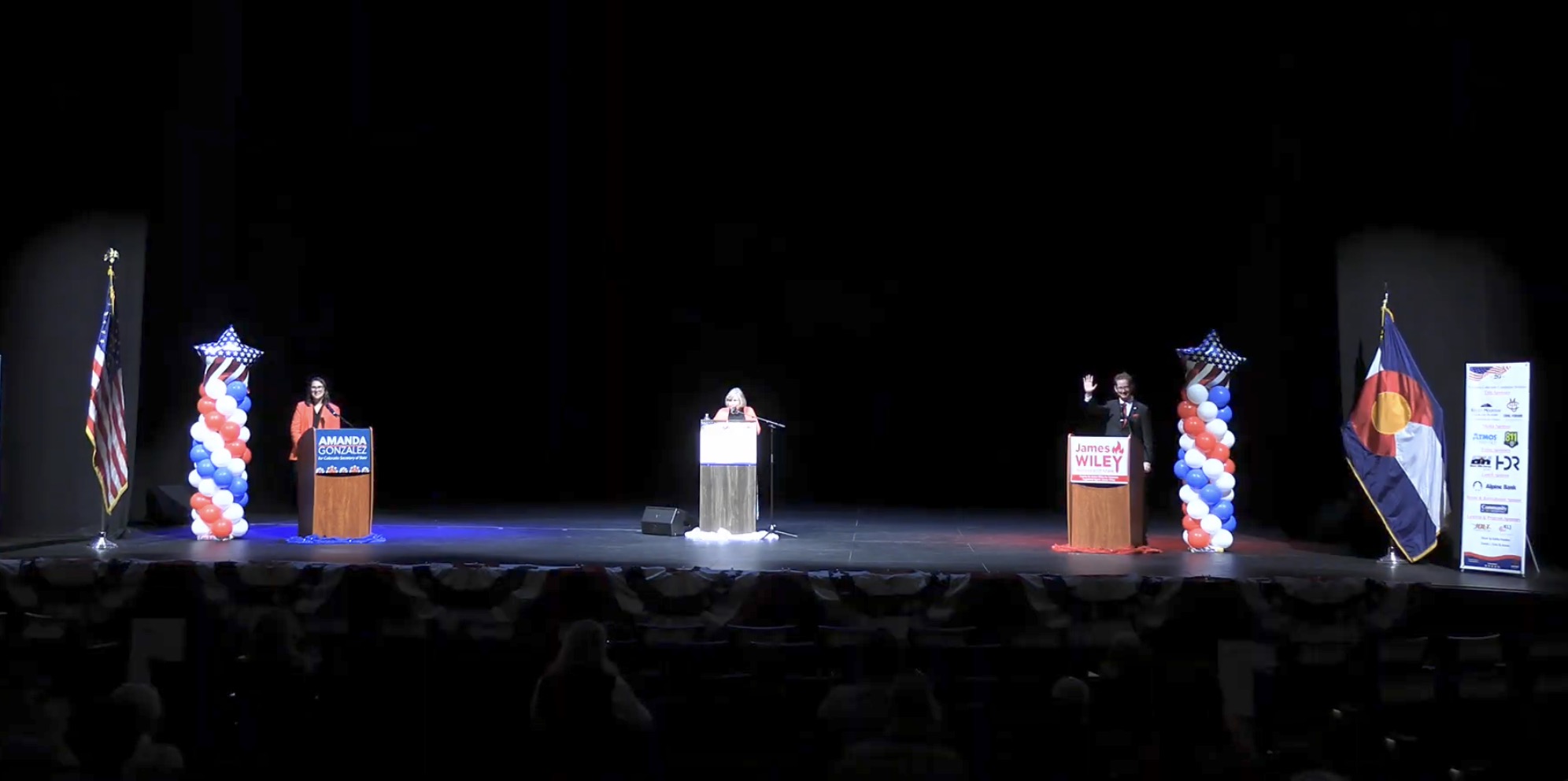
In western Colorado, the biggest political event each election cycle are the Club 20 debates held in Grand Junction, a tradition dating back decades. The lineup featured races from state house right up the ticket to Governor and U.S. Senate races, but this cycle’s event was defined by what was not discussed, who was not on the stage, and who wasn’t in the room.
The Colorado Mesa University’s newly constructed Asteria Theater was sparsely populated for the morning debates. First up was House District 55 where Democrat Brittni Packard is challenging incumbent Rick Taggart.
Packard won the coin flip, and launched into a full-throated denunciation of the politics of exclusion baked in the costs and format of the Club 20 debate. Packard noted that if she were attending the debate as a member of the public rather than as a candidate, the $165 ticket price for herself and her partner would total $330. She dressed the part of a people’s candidate; jeans and a nice t-shirt.
“There are working families across Mesa County who simply cannot spend hundreds of dollars to attend a political event. Their voices and their concerns deserve just as much access to the people asking to represent them,” she said.
City of Grand Junction’s own data has found that 55% of wage-earners in Mesa County cannot afford to rent on the free market, and boasts the highest rate of homelessness in the state.
“That’s more than two weeks’ worth of groceries for my family,” Packard stated.
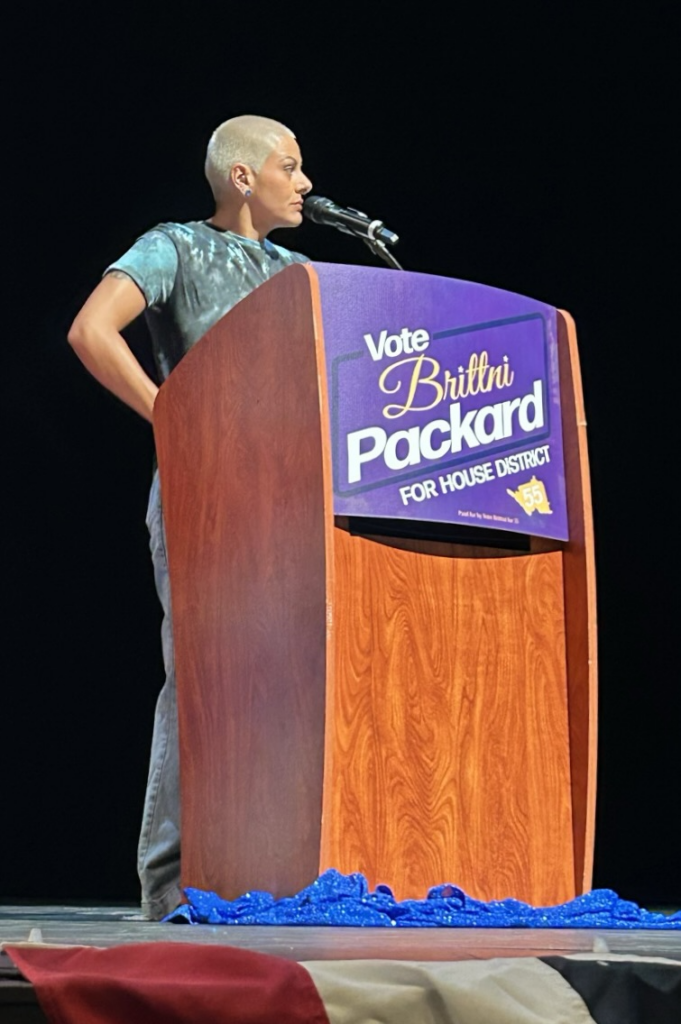
“I stand here today as someone who cannot be bought and sold by corporate interests or high-dollar donors,” Packard said. “My responsibility is to the people of this district, whether they can afford a $165 ticket or not.”
Packard then left the event, in a ‘mic-drop’ moment.
She had a point.
While Club 20 claims to be the “Voice of the Western Slope,” and that the debate serves to make “sure Western Colorado has a seat at the table.” The advocacy group is largely dominated by industry, wealthy individuals, and local governments.
Club 20’s sponsors are a who’s who of special interests: Rocky Mountain Health Plans and Common Spirit both United Health Care subsidiaries, Chevron, Xcel, Phillip Morris, Black Hills Energy, Atoms Energy, Swire Coca-Cola, Door Dash, Tri-State Energy, Flock Safety, Lockheed Martin, Guzman Energy, Pinnacol Energy, Charter (known to consumers as Spectrum internet), American Petroleum Institute, JOLT, ANB Bank, Alpine Bank.
This isn’t new, Club 20 has only represented the people of Colorado in name only from the very beginning.
Club 20 Director, Wade Haerle told talk show host Mandy Connel in a February interview that Club 20 was formed originally by thirteen people, mostly newspapermen with the Grand Junction Daily Sentinel and the Durango Herald, back in 1953. When they showed up in Denver to lobby that first year, “the last thing (founder) Preston Walker said was, ‘don’t tell anybody it’s just the thirteen of us,’” said Haerle with a laugh. These thirteen men just claimed to represent all 20 counties of western Colorado.
The first actual debate of the morning was between Mallory Martin and Jason Bias, for the seat held by Matt Soper, who is term-limited.
The format consisted of two-minute opening statements, followed by four questions from the moderator provided by Club 20 members and “our partners.” Candidates had one minute each to answer, and whoever answered first then had a thirty-second opportunity for rebuttals. Candidates then got four minutes each to ‘cross-examine’ their opponents. Followed by a two-minute closing statement by each candidate.
Bias unironically encouraged voters to be “Biased for Colorado.”
Bias has risen through the ranks of Turning Points USA, and was president of the CMU chapter, during a period of rising hate speech on the campus that ultimately culminated in his TPUSA associates forming a new club to host a white nationalist, Jared Taylor, on the campus in spring of 2025.
During cross, Martin confronted Bias on his preoccupation with culture war hot-takes, including recent public comments at December 2025 Mesa County Commissioner meeting where he said,
“In recent years [the library has] become very demonic, evil, while normalizing child gender mutilation, the same woke ideologies that have ruined our state, have targeted our schools, and are now trying to continue to ruin our libraries.”
Martin has been a driving organizing force with Indivisible Grand Junction, and asked voters to see through the “extremism disguised as passion,” and divisive culture war dog whistles, and toward her real world experience managing group homes for the developmentally disabled, for both the state and in the private sectors.
Martin was the only candidate who spoke directly to the needs and rights of Colorado’s LGBTQ+ communities from the stage.
One of the most bizarre performances of the day was delivered by Russ Andrews, the Republican challenger for the House District 57 seat held by Elizabeth Velasco. Andrews, a stock-broker, radio host, and Secretary of the Colorado Republican Party, leaned into the fire-hose technique and just kept throwing conspiracies and misinformation at the wall to see if any of it would stick.
“Colorado has been run by Democratic Socialists for nineteen years. Here is what my opponent and her comrades have delivered to us,” said Russ Andrews at the start of his opening statement. “Colorado is broken and my opponent and her party are culpable in breaking it,” and promised to reverse the “blue ruin.”
“Our cost-of-living skyrocketed by 26% on the Western Slope under Joe Biden’s reckless spending problems and Jared Polis and Elizabeth Velasco invited 350,000 illegals into our state and never stopped to think about where they house them, housing inventories plummeted which drove the prices of housing, food and healthcare through the roof,” alleged Andrews.
Though state demographics show that the number of foreign immigrants is at most 10% of that number. Later in the debate, he explained how he got that number. By taking the clearly questionable assumption that 17.5 million immigrants entered the US during the Biden administration, and then dividing it by 50, as if Hawaii and Texas have the same migration rates.
During cross, he went down a bizarre rabbit hole, when questioning Velasco about her ‘No’ vote on SB26-015, a law that created mandatory minimums for a number of crimes related to sexual exploitation of minors.
“I’m trying to imagine an 8-14 year-old kid that you know is chained to bed and gets sexually; sexually violated six to ten times a day, that’s what my opponent voted for.”
In reality, she voted against the bill, because mandatory minimums take power away from judges, are used as a cudgel by prosecutors to get guilty pleas, and that a one-size-fits-all approach doesn’t put victims first. “I’m an abolitionist. I believe that we should all have our basic needs met, that would make our society better,” said Velasco in an interview after the event.

The Colorado ACLU also opposed the bill. “Colorado should invest in meaningful prevention strategies, not double down on carceral penalties that fail to deter or rehabilitate offenders,” said Ariane Frosh testifying at the State House.
“Ms. Velasco always votes to protect illegal immigrants, especially criminal illegals, and the heinous vote on SB26-015 which subjects 300,000 kids to sexual exploitation,” Andrews said in closing.
Andrews was certainly not the only Republican to trade on conspiracy, poorly sourced contextless statistics, fantastical leaps in logic and fear mongering.
Velasco remained focused on the issues important to the people of Garfield, Pitkin and parts of Eagle County, like clean water, clean air and vibrant communities. Velasco was the only candidate to speak directly to challenges and needs facing our immigrant communities. According to census data, just shy of 20% of people living in Western Colorado are Hispanic.
“My district contains some of the greatest wealth inequality in the nation,” said Velasco “and I will continue to put our workers first.”
The race for Colorado’s House District 13, was a breath of fresh air, both for its civility and its productivity. Miguel Martinez, a former Democrat turned Republican, is running against Democrat Consuelo Redhorse.
The first question asked candidates to identify one state mandate or policy that is not working, and an audible gasp could be heard when Martinez identified the sacred cow of Colorado Republican politics as the problem.
“I think the thing we hear talked about most is TABOR, I think it’s TABOR,” said Martinez. Adding, “Repealing it is not a substitute for living within a budget.” TABOR, or Taxpayers’ Bill of Rights, is the 1993 constitutional amendment that prevents lawmakers from raising taxes and prevents government revenue from growing along with the state.
He proposed caps on the re-evaluation of your home’s value and repealing sales tax on groceries. Some of the only policies delivered by a Republican to directly address the affordability crisis, and not some exoteric re-explaination of failed trickle-down economics.
During the cross-examination, Martinez congratulated Redhorse on her primary victory, calling it ‘unprecedented.’ She asked him about why he switched his party affiliation.
“…I coined the term –at the time I was one of us– I called us the ‘do-nothing Dems,’ because I question what were we going to do in the future when people are asking where’s the affordable housing, where’s the affordable healthcare, where’s the affordable energy, and all we did was virtue signal and say all those flashy words … and do nothing,” said Martinez. “That got me run out of the party.”
“My promise is to approach things in the same manner as I did as an assessor, because math is not partisan,” said Martinez. Despite numerous attempts at red-baiting and fears of socialism from the Republicans, Martinez followed the numbers into saying the most socialist statement of the event: he expressed concerns about how affordable housing is currently being built in Colorado.
“All too often [private/public partnerships] end up only resulting in the private side making the benefit. … So these incentive deals we are handing out in all these communities should benefit us before developers. And if we are partners, let’s be partners, and let’s share in the profits on the sale side. We haven’t done that yet,” Martinez said.
Martinez was the only candidate to state clearly that 47 miles of Colorado’s second-largest river is soon going to be de-watered. “The Gunnison River is set to go dry in October.”
The morning debates can be viewed here.
Lunch was sponsored by Alpine Bank, serving an arugula and parm salad, with chicken parmesan and orecchiette pasta with a puttanesca sauce.
After lunch, incumbent Dylan Roberts, and his Republican challenger Corey Marshall for Colorado’s Senate District 8 spoke right past each other. The debate was between reality and Marshall’s hyperbolic fears of socialism. Roberts mopped the floor with him by remaining “focused on actual issues.”
Jeff Bridges, Democrat running for Colorado State Treasurer, was one of the few people that came to the stage with one big, well-thought-out idea. Bridges proposed using some of Colorado’s $6 billion in assets to invest in Colorado business and back mortgages for Colorado home buyers. He pointed to similar and effective efforts in Nevada and Vermont. Bridges argued that Colorado’s wealth is already backing mortgages and investing in companies across the nation, and a portion of which could be brought home to both earn a return for the state while supporting Colorado companies and families. Bridges, who holds a theology degree, called it “a moral imperative.”
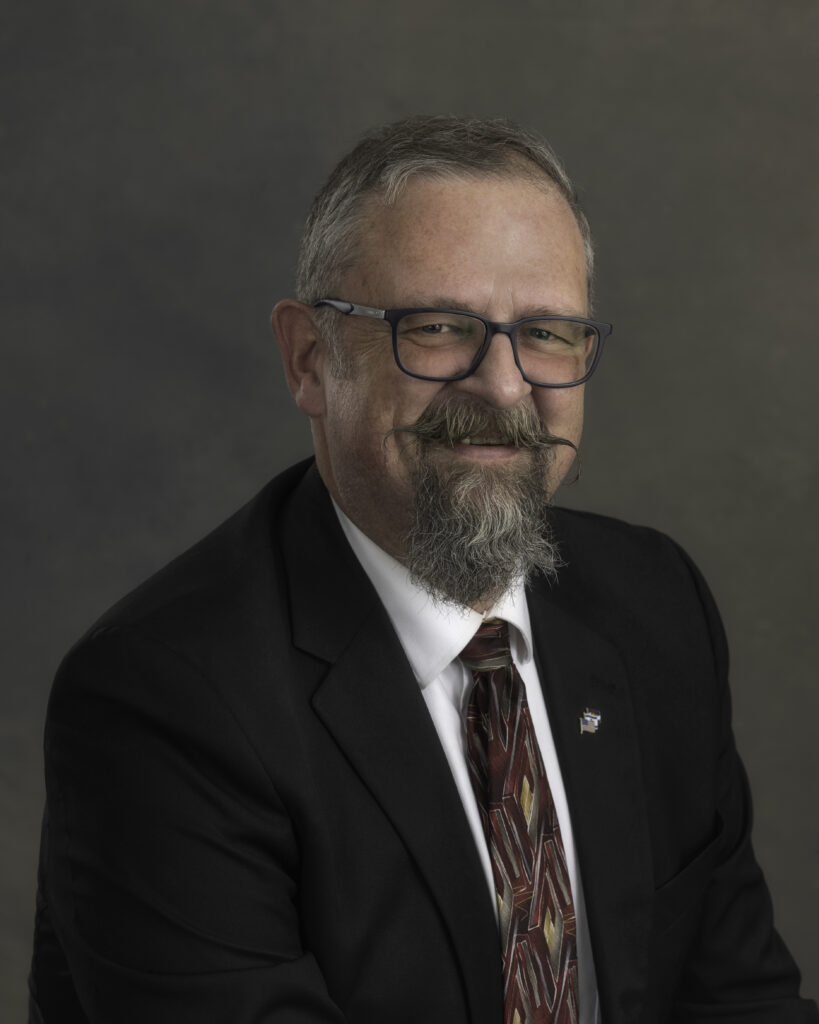
Bridges and his opponent, former state Senator Kevin Grantham, were both on the Colorado Joint Budget Committee a decade ago. While they disagreed on the issues, the old colleagues offered an example of how debates could be without the political noise of dog whistles and virtue signalling.
Bridges got laughs while cross-examining Kevin Grantham. He asked about his opponent’s robust moustache, and its care routine, and got a redirect by the moderator.
The other statewide debate was anything but civil or productive. It pitted conspiracist Libertarian-turned-Republican James Wiley against Amanda Gonzales, a Democrat and the current Jefferson County Clerk, an elections attorney who previously ran Common Cause Colorado, a non-partisan voter rights organization.
Wiley opened with a sermon about the Constitution, leaned into electoral fraud conspiracism, and argued for local control of elections which would bring up constitutional “equal protection” issues, as Gonzalez later pointed out.
Wiley seemed more interested in debating the current Secretary of State’s record than he was the issues or his opponent.
He grandstanded on the threat socialism poses to our democracy, tried to get Gonzalez to condemn socialism, and was redirected by the moderator. Gonzalez tried to get him to condemn the election conspiracy-driven Jan. 6 riot, but was also redirected by the moderator. Gonzalez objected given the ideological underpinnings of January 6th, but time ran out before Wiley could answer.
Through the barrage of red-baiting, what-if scenarios, and dog-whistles, Gonzalez was calm, professional and informed.
Voter fraud, especially in western Colorado, is a Republican problem, and strangely their biggest fear.
Just last week Daniel Brown, a 42-year old Republican was charged with casting his dad’s ballot in the 2026 Republican primary. In 2025, Jeff Small, with Republican influence firm 76 Group attempted to gain access to voting equipment from 10 Republican Clerks and Recorders across the state. In 2024, Republican Sally Jane Maxedon pleaded guilty to stealing a dozen ballots with a friend to “test the voting system.”
Nationally, the Heritage Foundation, of Project 2025 notoriety, maintains a national database of election fraud cases dating back to 1982, It contains only 1619 cases, only 23 cases in Colorado, yet strangely it does not include the GOAT of Colorado voter fraud, Tina Peters’ conviction in the database.
Candidate for Colorado Attorney General Jena Griswold had a scheduling conflict and declined the invitation. Her competitor, El Paso County District Attorney Michael Allen delivered his stump speech alone on the stage.
The afternoon debates can be viewed here.
In total, two debates on the schedule didn’t happen at all. In Colorado’s 2nd Congressional District, which covers a limited part of North Western Colorado, incumbent Joe Neguse declined the invitation and his opponent, Kelley Dennison, did not show up despite having confirmed she would attend. The morning debate for House District 58 was also cancelled after Democrat Alec Lindeman failed to make the ballot due to a clerical error, and his opponent, Republican Larry Suckla also didn’t appear after confirming.
Similarly, John Hickenlooper declined the chance to debate Republican challenger Mark Baisley. In both House Districts 59 and 26, the Democratic incumbents declined to participate.
One long-time Club 20 member said that the trend of non-participation in the venerable Club 20 debates all started in 2018, when then-candidate Jared Polis declined to appear. At the time, there was widespread outrage at the snub.
This year it was the Republican gubernatorial nominee who passed. Victor Marx was the only Republican in a contested race who declined the invitation, though that follows his campaign’s pattern of refusing public debates.
So Phil Weiser instead debated a former Republican, Greg Lopez, who is running his third campaign for governor, this time as an independent. They agreed on many of the problems and differed only on how we would get to a solution.
Both expressed concerns about how wolf reintroduction has been handled, Lopez wanted to end the program, which is inconveniently part of Colorado’s constitution, approved by the voters of Colorado, Weiser, recognizing that wolf reintroduction is codified in state law, sought to modify how it should proceed. They also agreed that regulation is stifling small businesses. They both promised to protect Western Colorado water and to listen to and represent Western Colorado.
Lopez promised independence from either party and emphasized that more than 50% of voters are neither registered Republicans or Democrats.
Weiser pulled a power move for closing remarks, grabbing the mic, and coming out from behind the podium, Lopez, no slouch, did the same thing for his closing remarks.
Lopez attempted to pin Weiser down on his record, Weiser dodged, and they both seemed too polished. Weiser attempted to get Lopez to condemn recent statements by Marx.
The un-noteworthy exchange may have been a ‘galaxy-brained ploy’ by Weiser. If Marx receives less than 10% of the vote in November, the Republican Party will be relegated to the status of ‘minor party’ under Colorado election laws.
The lack of fireworks left the big event of the night being the Third Congressional District faceoff between U.S. Rep. Jeff Hurd (R-CO) and challenger Dwayne Romero of Pitkin County.
Romero brought every question back to provisions in the Big Beautiful Bill, which Hurd supported. Hurd had well-practiced defenses. They found some agreement, copping out of the moderator’s question about data centers. Both agreed it’s a decision for local communities.
Hurd repeatedly stressed his few votes that went against the Trump administration. Though his record shows that Hurd has voted with the administration 95% of the time. Romero got Hurd to affirm his support for the SAVE Act which would disenfranchise millions of Americans, especially women.
Romero pushed back against Hurd’s narrative of party independence. “No, actually, you voted against one tariff against Canada and you use that as a preformative little showboat… You’re trying to be a maverick. You’re not Tom Cruise here, bud.”
But despite the zinger, Romero was flustered during the cross-examination and led into a trap about leasing of public lands by Hurd, an attorney by trade.
Romero, ultimately, held his own. Recent polling has shown him and Hurd nearly tied for this historically Republican seat.
The evening debates can be viewed here.
Ultimately, what wasn’t addressed, topics not broached, said more about the event and this election cycle in western Colorado.
Nobody said ‘single-payer healthcare,’ nobody said the words ‘Gaza,’ ‘genocide’ or ‘Israel.’ Homelessness was not addressed, except as a stick to beat the Democratic-controlled state government. Billionaires and wealth inequality were largely off the table, as was universally unpopular Flock cameras. ICE and immigration were under-examined, and except for Brittni Packard’s early morning wake-up call and mic-drop, nobody mentioned big money in politics.
Other important issues, including Medicaid cuts, climate change, mass incarceration, and the likely prospect of the Gunnison River going dry next month, were barely mentioned.
Some issues were talked about simply too much: Wolves, losing ‘our western Colorado way of life,’ election fraud, socialism, DSA, regulation, unfunded mandates, and way too much lip-service to the affordability crisis with no policy solutions, beyond more failed trickle-down policies like tax cuts for the rich and de-regulation.
Club 20, is largely an organization out of touch with everyday people and the national policies affecting western Colorado. Members want to talk about rising costs to farmers and ranchers without talking about tariffs, the Iran War and diesel prices, or immigration policy.
It’s a group that wants to talk about wolf introduction, like it’s not in the state constitution and can just be ignored. It’s a group that wants to talk about “drill, baby, drill,” but doesn’t want to talk about oil spills and corporate accountability. A group that wants to talk about drought, but not climate change. A group that wants to mention the affordability crisis without talking about workers or wages.
Ultimately, it is a group working to make sure western Colorado “has a seat at the table,” but at the same time ensures working-class people of western Colorado don’t have a seat at the Club 20 table.
