


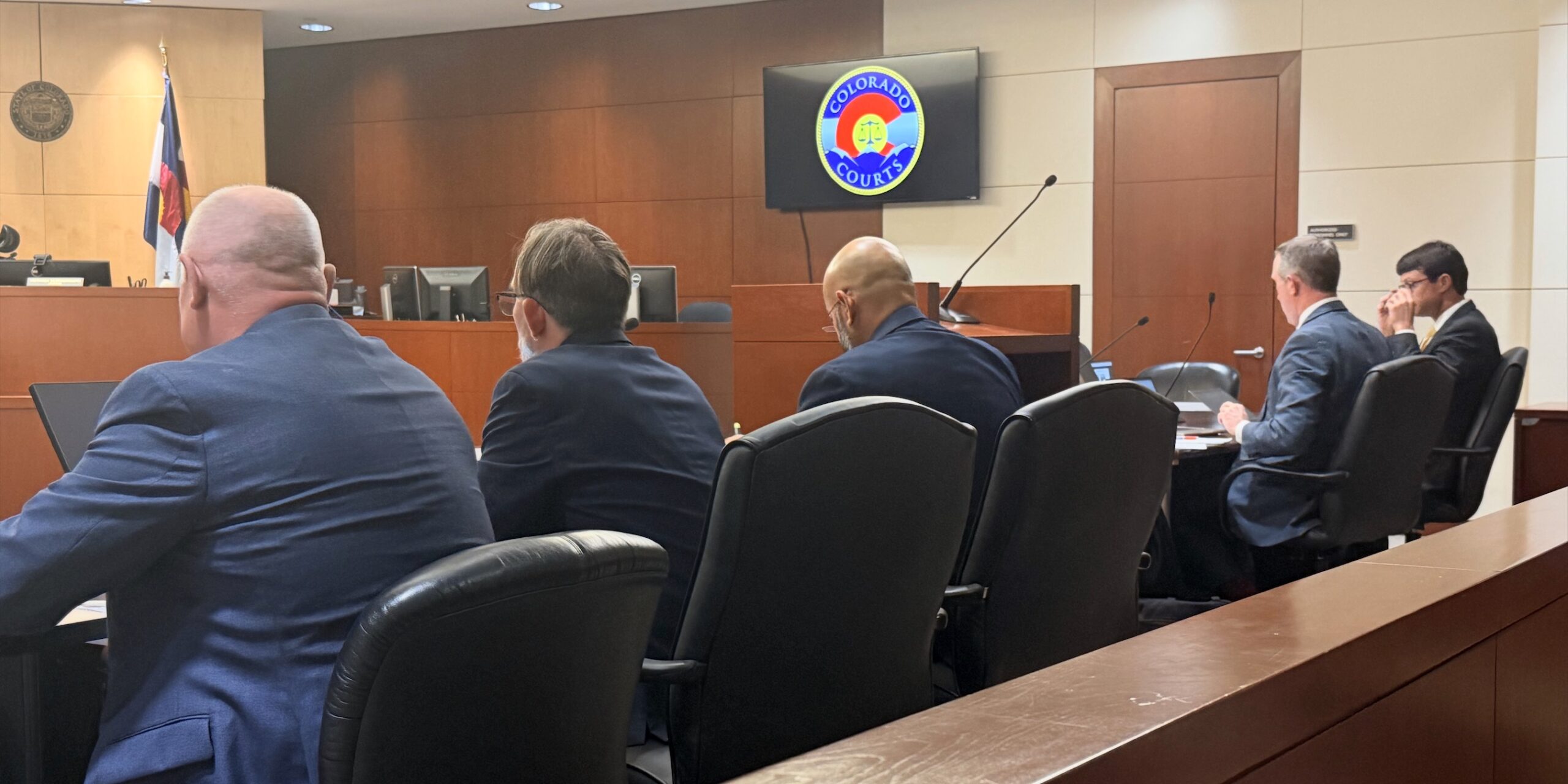
Every seat in Division 5 of the Douglas County courthouse was full a half hour before the hearing, leaving a few people sitting on the floor. Many of them spent the spring gathering signatures for the petition the hearing was about. None of the three commissioners, each named as a defendant in the suit, attended.
Douglas County District Judge Victoria Klingensmith ruled Friday afternoon that the commissioners’ rewrite of the citizens’ ballot question will go to voters as written, along with a second question the commissioners added asking whether all five commissioners should still be elected countywide. She didn’t rule on whether either one is lawful. Instead, she ruled that no law lets her decide that before an election.
State Rep. Bob Marshall, a Highlands Ranch Democrat, sued the county, the three commissioners, and the clerk on Sept. 7 to remove both changes before ballots are printed.
The board added a cost estimate of “$760,000 to $1.3 million” a year to the beginning of the question 20,434 people signed. The judge ruled that Marshall’s challenge to that language came too late under the state’s ballot-title statute.
On the second question, Marshall argued it was unlawful for the commissioners to put a single way of electing five commissioners before voters because the state law governing the shift from three to five requires offering at least two. Klingensmith agreed the wording doesn’t match that law. But a judge can only step in before an election to enforce the state’s election laws, she said, and that rule isn’t one of them. So the question stays on the ballot, and anyone who wants to challenge it will have to wait until after the vote.
“Where is my power to do something,” she asked Joseph Salazar, Marshall’s lawyer, “and especially to do what you’re asking me to do?”
Marshall’s window to ask the Colorado Supreme Court to review the ruling closed Monday, three days after the hearing. Any ruling after noon would’ve come too late to change the ballot language in time to print them and meet the deadline to send them to voters. He didn’t file.
What the commissioners changed
The petition, which volunteers turned in with nearly 23,000 signatures in July, asked the question: “Shall the membership of the Douglas County Board of Commissioners be increased from a three member board to a five member board.” If yes, voters would pick one of two ways to elect the five, both of which would put at least three seats in the hands of voters in that commissioner’s district.
The clerk approved that wording in March and certified the petition Aug. 12. Thirteen days later, Commissioners Abe Laydon, George Teal and Kevin Van Winkle, all Republicans, adopted a resolution making themselves the panel that sets ballot titles and hears protests of them.
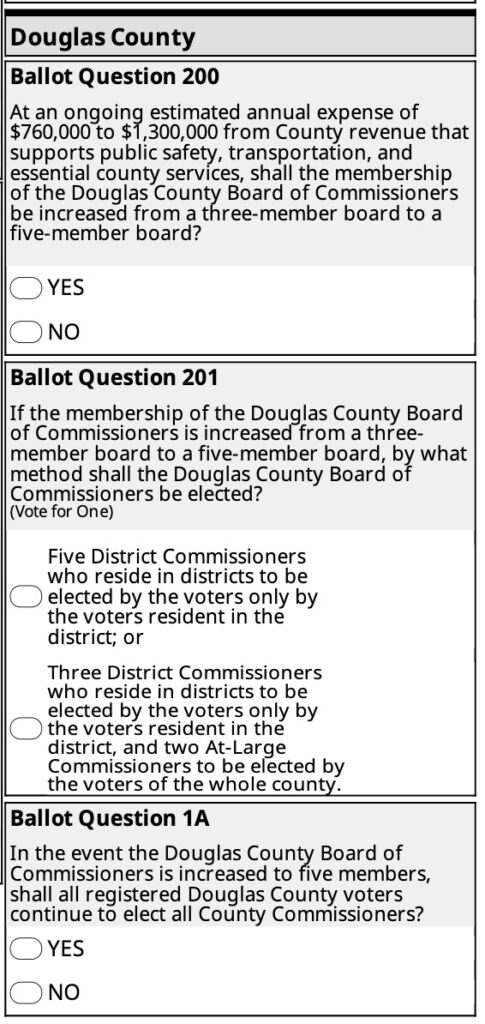
On Aug. 28 they rewrote the question so it opens, “At an ongoing estimated annual expense of $760,000 to $1,300,000 from county revenue that supports public safety, transportation and essential county services.”
At that same meeting, county staff put the cost of two more commissioners at $481,708 a year, far under the estimate the commissioners adopted.
On Aug. 31, the board decided to put another question to voters. It asks whether, if the board grows to five, “all registered Douglas County voters continue to elect all County Commissioners,” as they do now. Voters will see it as Question 1A, after the petition’s Question 200 (shall the board add two commissioners) and Question 201 (if added, shall commissioners be elected by each district or three districts and two at-large). It’s the one arrangement the petition doesn’t offer, and nothing on the ballot says which answer wins if voters say yes to all three.
The difference in nomenclature is worth noting. The three-digit format of Questions 200 and 201 indicates that they are on the ballot via the citizen petition process, as opposed to Question 1A, where the number-letter format is used because the question was referred directly to the ballot by the commissioners themselves.
Countywide elections have produced Republican commissioners in a county where Republicans are about a third of registered voters. District lines produce something else. Marshall won his Highlands Ranch House seat in 2022 as the first Democrat to represent Douglas County in the Legislature in more than 50 years.
The commissioners haven’t said that’s why they added 1A. The resolution’s title says it was referred “to preserve all Douglas County voters’ rights to elect all members” of the board.
“Sneaky hobbitses”
“These are sneaky hobbitses,” Salazar told the judge. “Well, that’s what R-62 is about,” he said, using the resolution number for 1A. “It’s about the county commissioners being sneaky hobbitses.”
Klingensmith smiled. The gallery laughed. Angela Thomas, who wrote the petition’s question and ran the campaign, sat among them.
His point was the phrase “in the event.” State law says a board that votes to expand itself to five must offer voters at least two ways to elect the new board. 1A offers only one. By writing it to take effect only “in the event” the board grows, Salazar argued, the commissioners made it look like something other than a vote to expand, so the two-ways rule wouldn’t apply.
Christopher Murray, arguing for the commissioners, said a court in a title contest can reword a title, not remove one. “All we can do here is say what words go on the ballot.”
Klingensmith said three times that 1A’s wording doesn’t match the law requiring two ways to elect the board. Still, she qualified that the court wasn’t making a judgment – only that from what she could see, “it doesn’t track that language.”
After a recess, she ruled that the election-duty statute Marshall relied on covers only duties “under this code,” the Uniform Election Code, and that the two-methods rule sits in the county-government title instead. Certifying a ballot, she said, “is not certifying the constitutionality or the compliance with statute” of a measure.
She said afterward that she “kept going back to” whether she could at least declare 1A out of step with the statute, and was “stuck” on why she couldn’t. Julian Ellis, Murray’s partner, told her the civil rules don’t apply to election cases at all.
“Your Honor, I see the angst on your face,” Ellis said. “There’s a remedy here. It is post-election.”
He meant that if voters approve 1A, someone can sue to have it thrown out on the grounds that the commissioners put it on the ballot illegally. Murray said the same thing earlier in the hearing. If he was wrong about which law applies, the referral would be “invalid post-election if it is adopted, and that would be the method to challenge this.”
The lawyer
Murray is a partner at First & Fourteenth PLLC in Englewood and the former general counsel to the Colorado Republican Party. He argued Friday between sessions of another hearing. On Sept. 10 and 11, the Secretary of State’s office was presenting its case for a $51,427 penalty against Victor Marx, the Republican nominee for governor, over 204 contributions above the legal limit, and Murray represents Marx. He left Castle Rock before the ruling and Ellis stood in.
The county’s engagement letter with the firm is dated Aug. 12, the day the clerk certified the petition, and signed by County Attorney Jeff Garcia the next morning. It lists Murray as billing $915 an hour. No lawsuit existed on Aug. 12. The board rewrote the petition’s wording 16 days later.
The county’s website, answering “How much is this costing the County?” about a separate open meetings appeal, says it pays outside counsel “between $495-$700 per hour.”
Teal’s response
Asked by email Saturday whether it would amend 1A before Monday, why it retained an election lawyer the day the petition qualified, and why no commissioner came to court, the board answered through Teal, or rather, declined to answer, but for one sentence.
“The Tolkien quote by the advocate for the Representative Marshall was interesting,” he wrote.
Laydon, Van Winkle and the county’s Clerk and Recorder office didn’t respond. The clerk’s office didn’t respond to questions about Monday’s print handoff.
What comes next
Marshall’s third claim, that the board discussed 1A in an Aug. 28 executive session called under a subsection of the Open Meetings Law that doesn’t exist, is still pending, the judge said. The same three commissioners are already before the Colorado Supreme Court over an April appellate court ruling that they violated the Open Meetings Law during last year’s home rule push.
Lora Thomas, the former Republican commissioner who brought that case with Marshall, said in a statement Monday that the ruling leaves citizens without a remedy.
“It’s unfortunate that the law offers no recourse to citizens trying to protect their right to petition against government abuse while giving that same government seemingly unlimited power to interfere and tamper with that important civil right,” she wrote. “However, I’m confident that, as in last year’s home-rule power grab vote, most voters will see through the attempt by this BOCC to subvert and sabotage the will of We the People and support better representation for everyone in Douglas County.”
Marshall, in a statement Monday, called it “disappointing that the court recognized the Commissioners failed to follow the law, but decided the court could not act until after an illegal measure passes into law.”
“Rather than engage in a fair political fight over the merits of the citizen proposal, three commissioners at the last minute before ballots must be printed changed what the citizens wanted on the ballot and referred their own measure to interfere with the petition signed by over 23,000 people,” he wrote. “Even worse, the commissioners used these same citizen tax dollars to pay $900+ hour attorneys to squash what the citizens put forward.”
Thomas said during Friday’s recess that she has run out of places to ask someone to intervene.
“The Secretary of State has told me they can’t hold them accountable. The Attorney General’s office has told me they can’t hold them accountable,” she said. “And so if a judge can’t hold them accountable, then they just get free rein.”
Both questions go to voters Nov. 3.
